
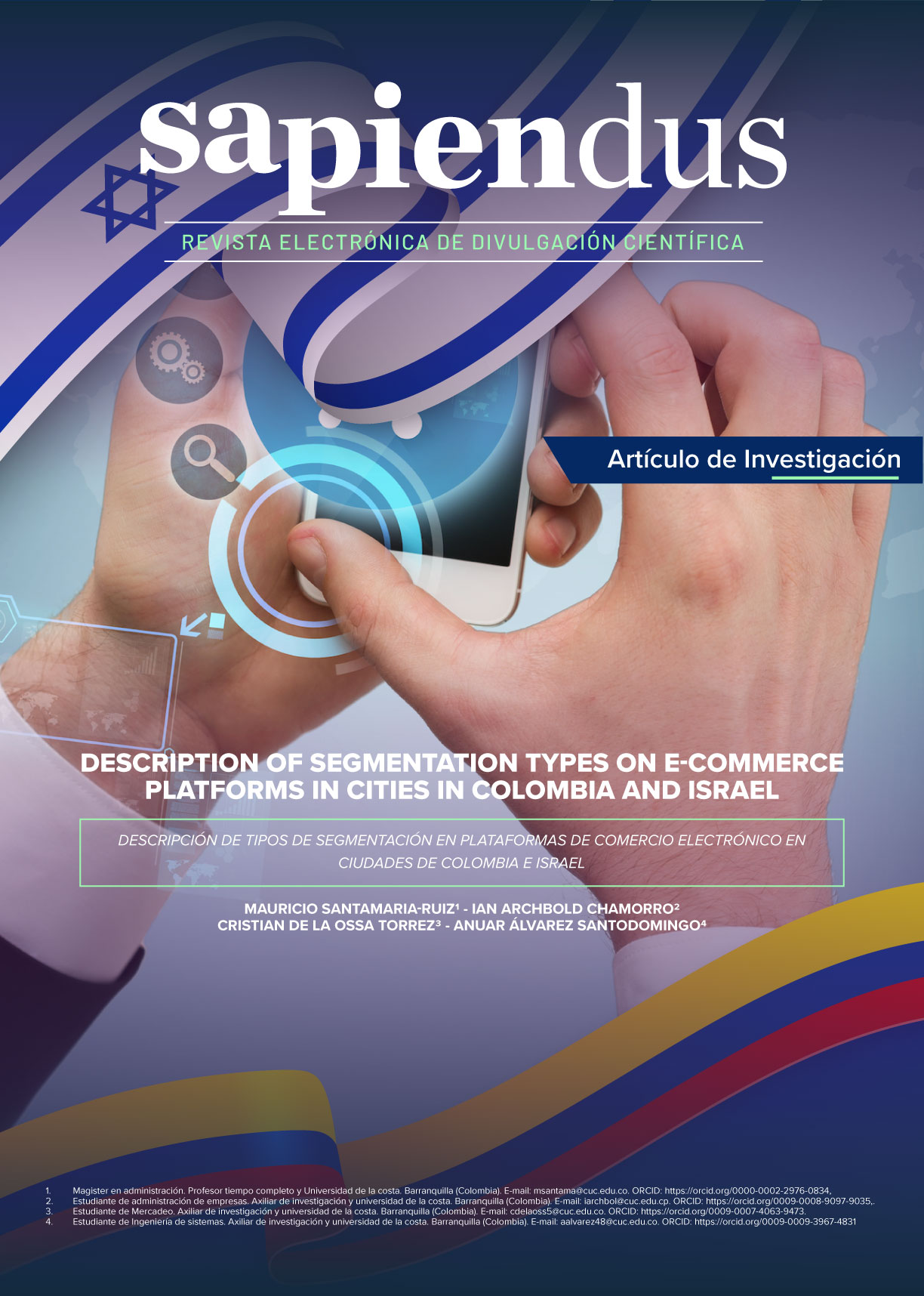
Descripción de tipos de segmentación en plataformas de Comercio electrónico en ciudades de Colombia e Israel
DOI:
https://doi.org/10.70335/sapiendus.1.1.10Palabras clave:
Publicidad, comercio electrónico, Marketing, Medios de comunicación de masasResumen
Introducción: La publicidad digital ha evolucionado con la llegada de la Industria 5.0, redefiniendo las estrategias promocionales y transformando la percepción del consumidor en plataformas de comercio electrónico. Objetivo: Este estudio tuvo como objetivo describir de tipos de segmentación en plataformas de comercio electrónico en ciudades de Colombia e Israel. Metodología: Se adoptó una metodología descriptiva dentro del paradigma postpositivista, utilizando encuestas dicotómicas aplicadas a 53 consumidores digitales. El instrumento fue validado mediante el índice KR-20, obteniendo una fiabilidad moderada (0,51). Resultados: Los resultados muestran una alta prevalencia de estrategias como la segmentación geográfica (4,15), el retargeting (4,38) y la segmentación conductual (3,77), mientras que la segmentación psicográfica fue moderadamente adoptada (2,55). Conclusiones: Se concluye que el uso estratégico del retargeting y la segmentación permite a las marcas generar mayor impacto en la experiencia del consumidor. Asimismo, se evidencia una transición hacia formatos publicitarios impulsados por inteligencia artificial y tecnologías inmersivas.
Descargas
Referencias
Armstrong, G., Adam, S., Denize, S., & Kotler, P. (2014). Principles of marketing. Melbourne: Pearson Australia Group.
Borg, K., Lindsay, J., & Curtis, J. (2021). Targeted change: Using behavioral segmentation to identify and understand plastic consumers and how they respond to media communications. Environmental Communication, 15(8), 1109-1126. https://doi.org/10.1080/17524032.2021.1956558
Brotspies, H., & Weinstein, A. (2019). Rethinking business segmentation: a conceptual model and strategic insights. Journal of strategic marketing, 27(2), 164-176. https://doi.org/10.1080/0965254X.2017.1384750
Davidson, D. (1991). Three varieties of knowledge. Royal Institute of Philosophy Supplements, 30, 153-166. https://doi.org/10.1017/S1358246100007748
Desimpelaere, L., Hudders, L., & Van de Sompel, D. (2022). Children’s hobbies as persuasive strategies: the role of literacy training in children’s responses to personalized ads. Journal of Advertising, 1-16. https://doi.org/10.1080/00913367.2022.2102554
Ferreira-Barbosa, H., García-Fernández, J., & Cepeda-Carrión, G. (2023). The Mediating Role of e-Lifestyles to Use the Fitness Center App. International Journal of Human–Computer Interaction, 1-10. https://doi.org/10.1080/10447318.2023.2204273
Griva, A., Zampou, E., Stavrou, V., Papakiriakopoulos, D., & Doukidis, G. (2023). A two-stage business analytics approach to perform behavioural and geographic customer segmentation using e-commerce delivery data. Journal of Decision Systems, 1-29. https://doi.org/10.1080/12460125.2022.2151071
Hayes, J. L., Holiday, S., & Park, H. (2022). Corporate social responsibility & the advertising strategic planning process: a literature review & research agenda. International Journal of Advertising, 41(2), 210-232. https://doi.org/10.1080/02650487.2022.2038432
Helmold, M. (2022). Market Segmentation, Targeting, Differentiation and Positioning. In Helmold, M. (2022), Performance Excellence in Marketing, Sales and Pricing: Leveraging Change, Lean and Innovation Management (pp. 105-116). Cham: Springer International Publishing.
Kim, J. (2021). Advertising in the metaverse: Research agenda. Journal of Interactive Advertising, 21(3), 141-144. https://doi.org/10.1080/15252019.2021.2001273
Lang, V. (2021). Digitalization and digital transformation. En V. Lang, Digital fluency: Understanding the basics of artificial intelligence, blockchain technology, quantum computing, and their applications for digital transformation (pp. 1-50). Editorial.
Lee, H., & Cho, C. H. (2020). Digital advertising: present and future prospects. International Journal of Advertising, 39(3), 332-341. https://doi.org/10.1080/02650487.2019.1642015
Li, H. (2019). Special section introduction: Artificial intelligence and advertising. Journal of advertising, 48(4), 333-337. https://doi.org/10.1080/00913367.2019.1654947
Liu, H., Huang, Y., Wang, Z., Liu, K., Hu, X., & Wang, W. (2019). Personality or value: A comparative study of psychographic segmentation based on an online review enhanced recommender system. Applied Sciences, 9(10), 1992. https://doi.org/10.3390/app9101992
Mark, T., Dhar, T., Verhoef, P. C., & Lemon, K. N. (2023). How is retargeting related to purchase incidence, channel choice, and purchase quantity?. Marketing Letters, 1-14. https://doi.org/10.1007/s11002-023-09693-4
Molina, R. I. R., Ruiz, M. J. S., Castro, L. C. M., Raby, N. D. L., Hinojoza-Montañez, S., & Samper, M. G. (2024). Bibliometric behavior of big data and digital marketing as real-time multimedia. Procedia Computer Science, 241, 526-532.
Permanasari, K. I., Sarosa, M., Moentamaria, D., & Zuhri, F. M. A. (2022). The influence of marketing mix and demographic segmentation on customer satisfaction. En Annual Management, Business and Economics Conference (Vol. 1, No. 1, pp. 144-149).
Preston, C. (2005). Advertising to children and social responsibility. Young Consumers, 6(4), 61-67. https://doi.org/10.1108/17473610510701322
Rathore, B. (2023). Digital Transformation 4.0: Integration of Artificial Intelligence & Metaverse in Marketing. Eduzone: International Peer Reviewed/Refereed Multidisciplinary Journal, 12(1), 42-48. https://www.eduzonejournal.com/index.php/eiprmj/article/view/248
Ruíz, M. J. S., Barragán, B. P., & Hinojoza-Montañez, S. D. (2023). Advertising targeting trends: Retargeting and new technologies user perception of e-commerce platforms in Colombian and Israeli cities. NovaRua, 15(27).
Ruiz, M. J. S., Samper, M. A. G., Forero, M. P., Lara, P. C., Morales, C. B., & Carpio, D. S. (2025). Customer segmentation analysis with big data in health services companies in Colombia: case study. Procedia Computer Science, 257, 1134-1139.
Ruiz, M. J. S., Arrieta, A. A. M., & Hinojoza-Montañez, S. D. (2024). Innovation in the Customer Service Process Through a Virtual Assistant for Website Users: A Case Study in Colombia. InGente Americana, 4(4).
Ruiz, M. J. S., Calderón, C. E. J., Venecia, A. R. O., Santodomingo, A. A., & Forero, M. P. (2025). Bibliometric behavior of artificial intelligence and digital marketing sustainability. Procedia Computer Science, 257, 1047-1052.
Sayoh, M. M. R. (2023), Utilizing Artificial Intelligence in Digital Out-of-Home Advertising. International Design Journal, 13 (4), 417-425. https://dx.doi.org/10.21608/idj.2023.305380
Stidsen, B. (1975). Market segmentation, advertising and the concept of communication systems. Journal of the Academy of Marketing Science, 3, 69-84. https://doi.org/10.1007/BF02729959
Subawa, N. S., Widhiasthini, N. W., Astawa, I. P., Dwiatmadja, C., & Permatasari, N. P. I. (2021). The practices of virtual reality marketing in the tourism sector, a case study of Bali, Indonesia. Current Issues in Tourism, 24(23), 3284-3295. https://doi.org/10.1080/13683500.2020.1870940
Sung, E. C. (2021). The effects of augmented reality mobile app advertising: Viral marketing via shared social experience. Journal of Business Research, 122, 75-87. https://doi.org/10.1016/j.jbusres.2020.08.034
Zatonatska,T.,Dluhopolskyi,O.,Artyukh,T. & Tymchenko,K.(2022).Forecasting the Behavior of Target Segments to Activate Advertising Tools: Case of Mobile Operator Vodafone Ukraine. ECONOMICS,10(1) 87-104. https://doi.org/10.2478/eoik-2022-0005
Zierau, N., Hildebrand, C., Bergner, A., Busquet, F., Schmitt, A., & Marco Leimeister, J. (2023). Voice bots on the frontline: Voice-based interfaces enhance flow-like consumer experiences & boost service outcomes. Journal of the Academy of Marketing Science, 51, 823-842. https://doi.org/10.1007/s11747-022-00868-
Archivos adicionales
Publicado
Número
Sección
Licencia
Derechos de autor 2025 Sapiendus

Esta obra está bajo una licencia internacional Creative Commons Atribución-NoComercial-SinDerivadas 4.0.
Bajo las condiciones siguientes:
-
Reconocimiento — Debe reconocer adecuadamente la autoría, proporcionar un enlace a la licencia e indicar si se han realizado cambios<. Puede hacerlo de cualquier manera razonable, pero no de una manera que sugiera que tiene el apoyo del licenciador o lo recibe por el uso que hace.
-
NoComercial — No puede utilizar el material para una finalidad comercial.
-
SinObraDerivada — Si remezcla, transforma o crea a partir del material, no puede difundir el material modificado.
- No hay restricciones adicionales — No puede aplicar términos legales o medidas tecnológicas que legalmente restrinjan realizar aquello que la licencia permite.