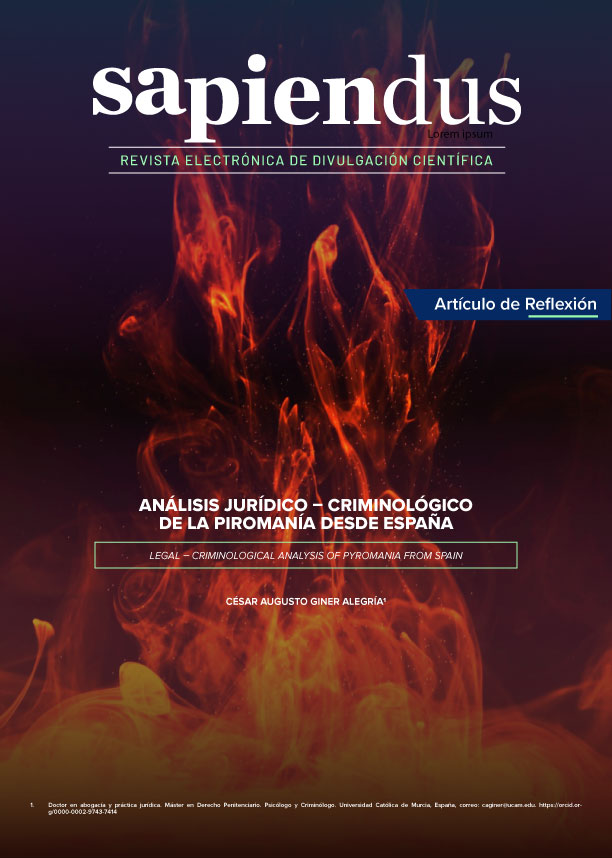
Legal – Criminological Analysis of Pyromania from Spain
DOI:
https://doi.org/10.70335/sapiendus.1.1.2Keywords:
Behavior, delinquency, law, criminology, psychologyAbstract
Introduction: This reflective article aims to delve into the understanding of pyromania from a dual perspective: on the one hand, addressing the legal treatment of crimes related to intentional arson. Objective: To analyze the figure of the pyromaniac subject from a legal-criminological perspective in order to develop the factors, causes, and circumstances surrounding them. Methodology: Documentary research is the fundamental technique used in the preparation of this work, drawing on a set of legal data (court rulings, criminal legislation), psychobiological data (treatment), and press sources. Conclusions: The most frequent motivations of arsonists are psychological factors related to some type of behavioral disorder, acts of revenge, economic interests, arson associated with vandalism, and the destruction of evidence.
Downloads
References
Arias, S. (2015). El colectivo de mayores de 65 años, el más vulnerable ante los incendios. En La Fundación, 30. Fundación Mapfre. pp. 59-61.
Aniceto Del Castillo, J. J. (2008). ¿Incendiario o Pirómano? Claves para la determinación de la Piromanía como causa de los incendios forestales. Universidad de Cádiz. pp. 40-41.
Barnoux, M. F. & Gannon, T. A. (2013). A new conceptual framework for revenge firesetting. En Psychology, Crime and Law, vol 20. Universidad de Kent. pp. 2.
Burton, P. R. S., McNiel, D. E. & Brinder, R. L. (2012). “ Firesetting, arson, pyromania, and the forensic“Firesettingh expert”. En The Journal of the American Academy of Psychiatry and the Law, vol 40. American Academy of Psychiatry and the Law. pp. 357-358.
Cardil Forradellas, A. & Molina Terrén, D. M. (2013). “Víctimas en incendios forestales en el período 1980-2010”. En 6º Congreso Forestal Español. Sociedad Española de Ciencias Forestales. 2013. pp. 2-5.
Davis, J. A. & Lauber, K. M. (1999). Criminal Behavioral Assessment of Arsonists, Pyromaniacs, and Multiple Firesetters. En Journal of Contemporary Criminal Justice, 3, vol 15. Edit. Sage Publications. pp. 273-281
Glancy, G. D., Spiers, E. M., Pitt, S. E. & Dvoskin, J. A. (2003). Commentary: models and correlates of firesetting behavior. En The Journal of the American Academy of Psychiatry and the Law, 1, vol 31. American Academy of Psychiatry and the Law. pp. 54-56.
Ibáñez Cuadrado, A. & Saiz Ruiz, J. (2000). Trastornos de los hábitos y del control de los impulsos. En Barcia Salorio, D. Tratado de Psiquiatría. Edit. Arán. S.A. Madrid. pp. 579-580.
Johnson, R. S. & Netherton, E. (2017). Fire Setting and the impulse-control disorder of Pyromania. En The American Journal of Psychiatry Residents’ Journal, vol 11. Edit. American Psychiatric Association Publishing. pp. 14-16
Kephart, C. M. (2001). Factors that influence coping following residential fire: the roles of attributional style and family functioning. Universidad Politécnica de Virginia. pp. 2-5.
Ley Orgánica 1/2015, de 30 de marzo, por la que se modifica la Ley Orgánica 10/1995, de 23 de noviembre, del Código Penal.
Martínez Ripoll, V., Oña Socias, C. & Dámaso Fernández, A. (2016). “Piromanía, un trastorno de control de los impulsos poco común”. En Molero, Mª del M. et al. Intervención en contextos clínicos y de la salud. Edit. ASUNIVEP. p. 407.
Palermo, G. B. A look at firesetting, arson, and pyromania. En International Journal of Offender Therapy and Comparative Criminology, vol 59. Edit. Sage Journals. 2015. pp. 683-684.
Stewart, L. A. (1993 ). Profile of female firesetters: implications for treatment. En The British Journal of Psychiatry, 2, vol 163. Royal College of Psychiatrists. pp. 252-253.
Tiffon Nonnis, B. N. (2008). Una trimorbilidad forense emergente: el trastorno de personalidad, el trastorno del control de los impulsos y el abuso de sustancias tóxicas. En Anuario de Psicología Jurídica, vol 18. Colegio Oficial de Psicólogos de Madrid. pp. 92-93.
Villarejo Ramos, A. (2012). Las bases biopsicológicas de la imputabilidad en la conducta impulsiva. En Cuadernos de Medicina Forense, 2, vol 18. Edit. Asociación de Médicos Forenses de Andalucía. pp. 64-66.
Additional Files
Published
Issue
Section
License
Copyright (c) 2025 Sapiendus

This work is licensed under a Creative Commons Attribution-NonCommercial-NoDerivatives 4.0 International License.
The author or authors of an article accepted for publication in the Journal Pensamiento Americano will transfer all of the patrimonial rights to the American University Corporation free of charge, within which are included: the right to edit, publish, reproduce and distribute both print media as digital, in addition to include in article in international indexes and / or databases, likewise, the Editorial Seal is authorized to use the images, tables and / or any graphic material presented in the article for the design of covers or posters from the same magazine. By assuming the patrimonial rights of the article, it may not be partially or totally reproduced in any printed or digital media without its express permission.
AUTHORITY ASPECTS
For the Pensamiento Americano Journal, all the authors of an article have made substantial contributions to the research and the manuscript, and they share the responsibility when the article presents errors, fraud in some way or violations of copyright.
After submitting an article, the journal does not accept the addition, deletion or change in the order of the authors, in addition we reserve the right to release the article when it has been submitted to the journal and under no circumstances will American Thought accept the article. withdrawal of an article during any phase of the editorial process