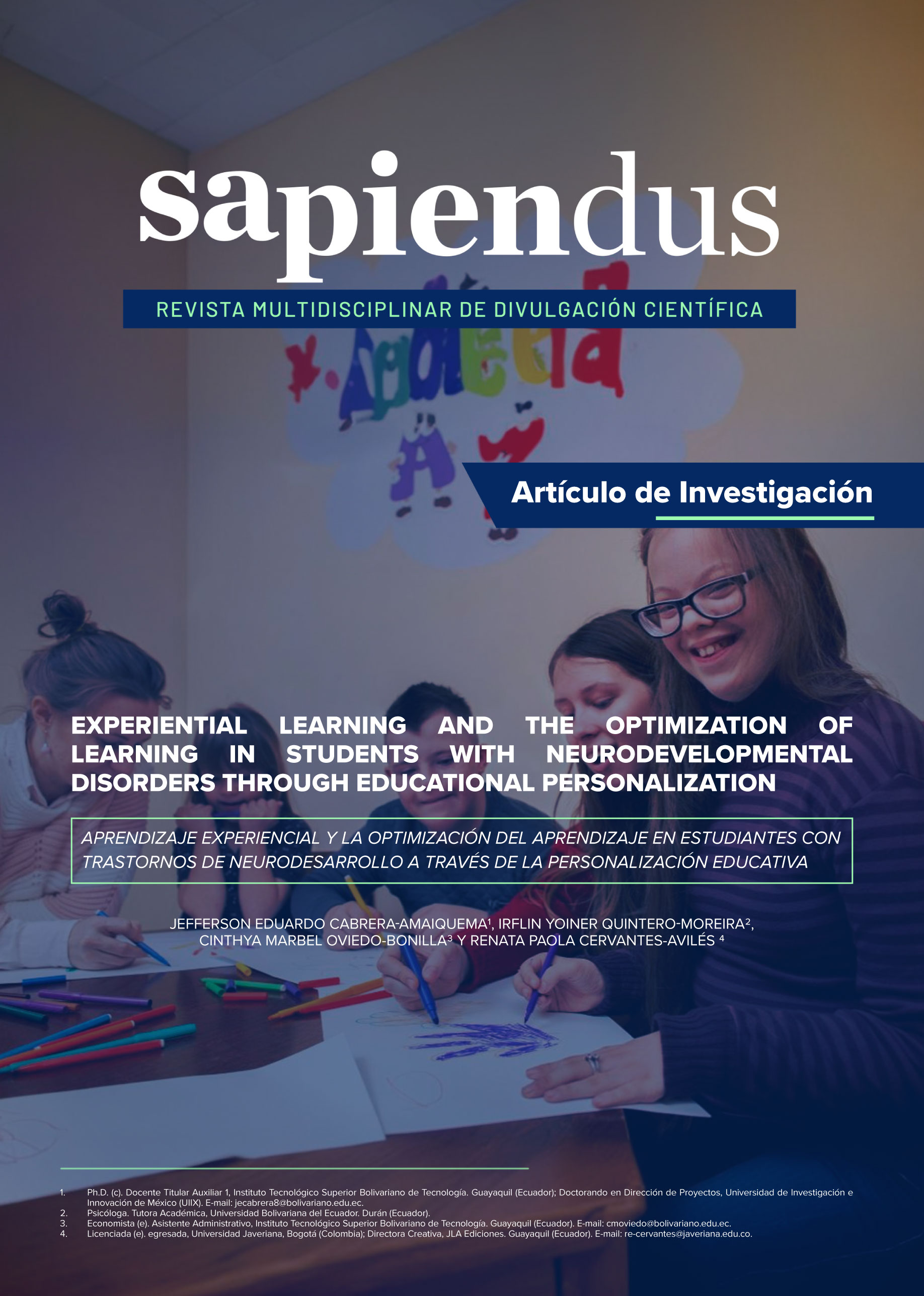
Experiential Learning and the Optimization of Learning in Students with Neurodevelopmental Disorders through Educational Personalization
DOI:
https://doi.org/10.70335/sapiendus.1.1.5Keywords:
personalized education, neurodevelopmental disorders, educational inclusion and planning, adaptive learning, pedagogical strategiesAbstract
Introduction: This study examines the impact of experiential learning and educational personalization on students with neurodevelopmental disorders, such as ADHD, ASD, SLI, and dyscalculia, through innovative methodologies focused on educational inclusion. Objective: To evaluate how educational personalization, through strategies such as learning through play and plastic expression games, optimizes the learning process and reduces barriers in the educational environment. Methodology: The research was conducted in educational institutions in Guayaquil, employing a quantitative approach with data collection and analysis techniques using SPSS. Indicators of performance, effort, stress, and learning perception were analyzed in neurodivergent students. Results: Findings reveal significant improvements in learning efficiency and performance perception, as well as a reduction in stress and frustration levels. Additionally, the study highlights the importance of interinstitutional collaboration and family involvement in teaching-learning processes. Conclusions: Experiential learning-based educational personalization proves to be an effective and viable strategy for inclusive education. Its integration into curricular planning can enhance teaching across various educational levels, fostering students’ holistic development.
Downloads
References
Acosta, A., Mejía, W. & González, A. (2022). Coeficiente intelectual y rendimiento académico en un grupo de estudiantes de primer semestre de Psicología. Pensamiento Americano, e#:456. 15(29), 153-167. DOI: https://doi.org/10.21803/penamer.15.29.456
Bermejo, F. R. (2024, February). Trastorno por déficit de atención e hiperactividad: perfil neuropsicológico y estudio de su impacto en las funciones ejecutivas y académicas. In Anales de Pediatría (Vol. 100, No. 2, pp. 87-96). Elsevier Doyma.
Delgado-Mendoza, E. I., Mendoza-Figueroa, D. V., Bernal-Cerza, R. E., & Ortiz-Aguilar, W. (2024). Estrategia neurodidáctica para mejorar el aprendizaje de la matemática en los estudiantes del séptimo grado. MQRInvestigar, 8(2), 1906-1929. https://doi.org/10.56048/MQR20225.8.2.2024.1906-1929
Forbes, M. K., Neo, B., Nezami, O. M., Fried, E. I., Faure, K., Michelsen, B., ... & Dras, M. (2024). Elemental psychopathology: Distilling constituent symptoms and patterns of repetition in the diagnostic criteria of the DSM-5. Psychological Medicine, 54(5), 886-894. https://doi.org/10.1017/S0033291723002544
Garzón, B. C. R., Parra, J. C. A., & Vásquez, V. J. C. (2024). El rol de la tecnología para el desarrollo de habilidades multisensoriales en niños con TDAH. Ciencia y Educación, 282-295. https://doi.org/10.5281/zenodo.13997112
Guerrero-Altamirano, N. L. (2023). Metodologías activas y gamificación para el desarrollo del pensamiento lógico matemático en estudiantes de sexto grado: Ensayo sobre la Unidad Educativa “17 de ABRIL”. YUYAY: Estrategias, Metodologías & Didácticas Educativas, 2(1), 203–215. https://doi.org/10.59343/yuyay.v2i1.40
Gutierrez, E. E. (2024). Tratamiento del TDAH en Adolescentes Impacto en Perfeccionismo Atención Plena y Bienestar en un Ensayo Controlado: Treatment of ADHD in Adolescents Impact on Perfectionism, Mindfulness and Well-being in a Controlled Trial. Revista Latinoamericana de Calidad Educativa, 1(4), 144-150. https://doi.org/10.70625/rlce/44
Peláez, O. A., Echeverri, L. F., & Castrillón, E. F. (2022). La percepción instrumentalizada del inglés para la competitividad: un caso de estudio. Pensamiento Americano, 15(29), 45-57. https://doi.org/10.21803/penamer.15.29.416
Rivadeneira Coello, J. N. (2024). Hiperactividad y su impacto en el proceso de aprendizaje de los niños de Inicial I (Bachelor's thesis, BABAHOYO: UTB, 2024).
Rivera, V., & Alicia, G. (2024). Impacto del TDAH en el aprendizaje de estudiantes en edad escolar: una revisión sistemática. Revista San Gregorio, 1(57), 199-219. https://doi.org/10.36097/rsan.v1i57.2329
Sanmartín, M., Tufiño, A., Suárez, J., & Albán, D. S. V. (2024). Implementación de la aplicación Plickers como herramienta tecnológica para promover el aprendizaje de matemáticas en estudiantes con TDAH: Implementation of the Plickers application as a technological tool to promote mathematics learning in students with ADHD. LATAM Revista Latinoamericana de Ciencias Sociales y Humanidades, 5(5), 4915-4937.
Serrano-Macias, J. H. (2022). De lo experimental a lo creativo: Metodología Didáctica para aprender jugando. YUYAY: Estrategias, Metodologías & Didácticas Educativas, 1(1), 51–70. https://doi.org/10.59343/yuyay.v1i1.5
Serrano-Macías, J. H., Cabrera-Amaiquema, J.E., Aragundy-Cornejo, A.A. (2024) Juegos de expresión desde la plástica “JEP”: Espacios, Metodologías y Vínculos desde, para y a través de las artes. Eduación Transformadora: Innovación, Inclusión y Calidad en el Siglo XXI Ed. 21Chapther. VII. Egregius Ediciones
Vaca, J. A. P., Yánez, E. G. V., Otavalo, M. D. J. T., Tipán, K. Y. V., & Otavalo, M. M. C. (2024). Impacto de las intervenciones psicopedagógicas en el rendimiento académico de niños con TDAH: un análisis crítico. Arandu UTIC, 11(2), 1-22. https://doi.org/10.69639/arandu.v11i2.242
Additional Files
Published
Issue
Section
License
Copyright (c) 2025 Sapiendus

This work is licensed under a Creative Commons Attribution-NonCommercial-NoDerivatives 4.0 International License.
The author or authors of an article accepted for publication in the Journal Pensamiento Americano will transfer all of the patrimonial rights to the American University Corporation free of charge, within which are included: the right to edit, publish, reproduce and distribute both print media as digital, in addition to include in article in international indexes and / or databases, likewise, the Editorial Seal is authorized to use the images, tables and / or any graphic material presented in the article for the design of covers or posters from the same magazine. By assuming the patrimonial rights of the article, it may not be partially or totally reproduced in any printed or digital media without its express permission.
AUTHORITY ASPECTS
For the Pensamiento Americano Journal, all the authors of an article have made substantial contributions to the research and the manuscript, and they share the responsibility when the article presents errors, fraud in some way or violations of copyright.
After submitting an article, the journal does not accept the addition, deletion or change in the order of the authors, in addition we reserve the right to release the article when it has been submitted to the journal and under no circumstances will American Thought accept the article. withdrawal of an article during any phase of the editorial process