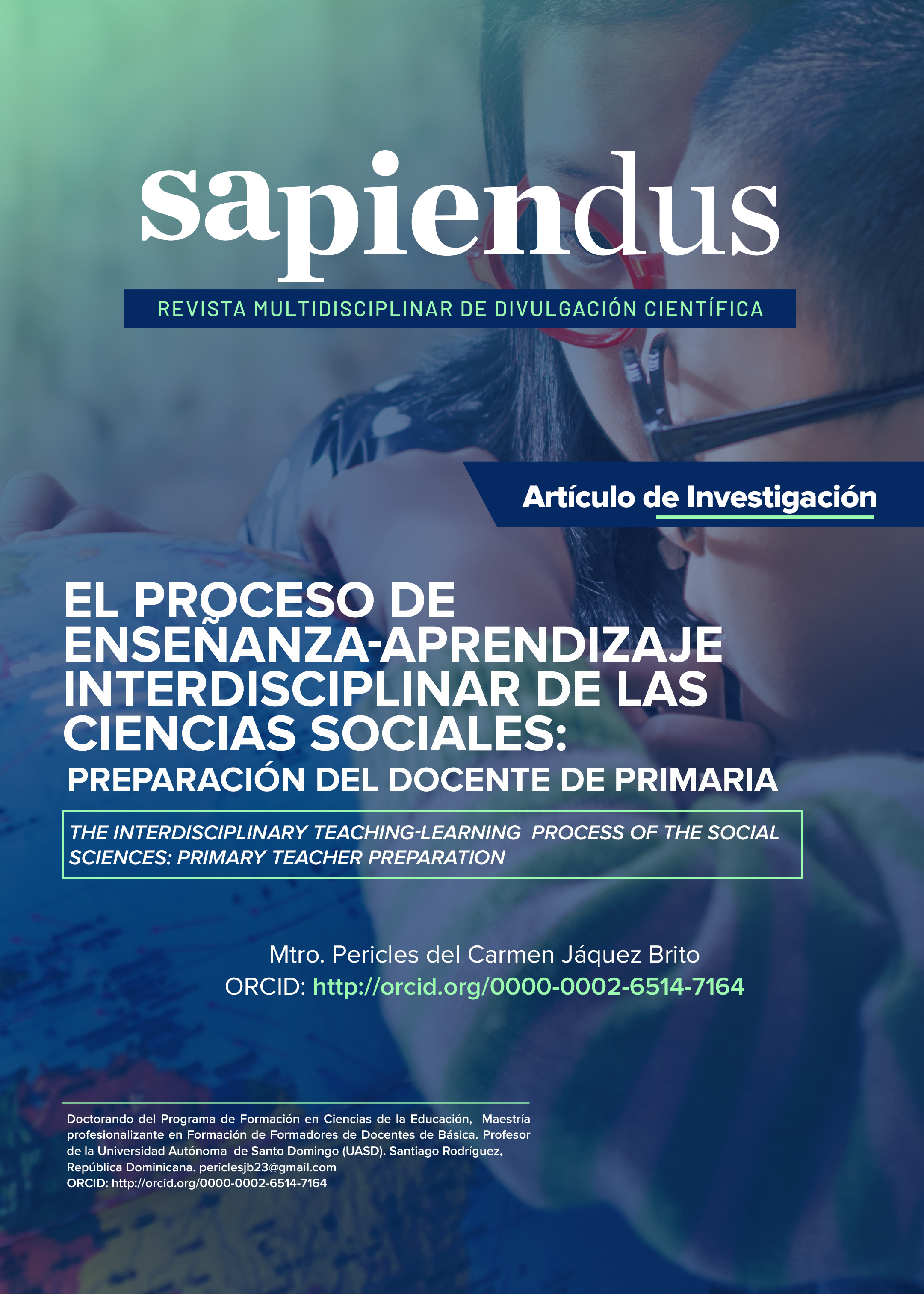
The interdisciplinary teaching-learning process of the social sciences: primary teacher preparation
DOI:
https://doi.org/10.70335/sapiendus.1.1.6Keywords:
Interdisciplinarity, Teaching-learning process, Social SciencesAbstract
Introduction: The teaching of Social Sciences is of great importance in the formation of subjects and, therefore, has an impact on the development of any society. However, in the Dominican Republic, the teaching-learning process of this curricular area at the primary level shows insufficiencies that indicate in the students' learning. Objective: to contribute to the improvement of the teaching-learning process of Social Sciences in the first cycle of the primary level, with an interdisciplinary approach, emphasizing the teacher's preparation. Methodology: methods will be used empirical, theoretical and statistical studies to establish the current situation of the object of study, as well as the review of articles in high impact journals and research related to the interdisciplinary teaching-learning process of Social Sciences. Results: there is an empirical study associated with the interdisciplinary teaching-learning process of Social Sciences in the first cycle of Primary Level in the educational district 09-03 of the Dominican Republic. Conclusions: A didactic strategy is proposed for the preparation of teachers, tending to contribute to the improvement of the interdisciplinary teaching-learning process of Social Sciences, in the referred educational cycle.
Downloads
References
Addine, F., Recarey, S., Fuxá, M., & Fernández, S. (2020). Didáctica: teoría y práctica. Editorial Pueblo y Educación.
Alcívar, J. C., & Zambrano Montes, L. C. (2021), octubre-diciembre. Estrategias didácticas interdisciplinarias en el aprendizaje significativo a los estudiantes de la escuela unidocente. Dominio de las Ciencias, 7(6), 1144-1165. http://dx.doi.org/10.23857/dc.v7i6.2387.
Arteaga Alcívar, Y. A., Guaña Moya, E. J., Begnini Domínguez, L. F., Cabrera Córdova, M. F., Sánchez Cali, F., & Moya Carrera, Y. (2022). Integración de la tecnología con la educación. RISTI - Revista Iberica de Sistemas e Tecnologias de Informacao, 2022(E54), 182-193.
Barrios Silva, C. (2020), abril-junio. La formación interdisciplinaria del maestro primario desde la Educación Agropecuaria en la Escuela Cubana actual. Mendive. Revista De Educación, 18(2), 394–411. https://mendive.upr.edu.cu/index.php/MendiveUPR/article/view/1689
Bell, R., Orozco, F. y Lema, C. (2022). Interdisciplinariedad, aproximación conceptual y algunas implicaciones para la educación inclusiva. Uniandes EPISTEME. Revista digital de Ciencia, Tecnología e Innovación, 9(1). 101-116.https://revista.uniandes.edu.ec/ojs/index.php/EPISTEME/article/view/2518
Deifan Paola, D. P., Simancas Trujillo, R. A., Higuera Ojito , V. H., & Miranda Passo, J. C. . (2024). Conditions and barriers to entrepreneurship: a review of the microbusiness ecosystem in Monteria, Cordoba. Salud, Ciencia Y Tecnología - Serie De Conferencias, 3, 1020. https://doi.org/10.56294/sctconf20241020
Díaz Solano, A. M., Fonseca, N. & Vázquez Gutiérrez, G. (2020). Interdisciplinariedad: reto en la formación del maestro primario en Cuba. Perspectivas: Revista de Ciencias Sociales, 5(10), 348-359. ISSN-e 2525-1112.
Gómez, L. A. O., Geremich, M. A. V., & De Franco, P. D. M. F. (2022). Elementos del proceso de enseñanza–aprendizaje y su interacción en el ámbito educativo. Revista Qualitas, 23(23), 001-011. https://doi.org/10.55867/qual23.01
Henríquez-Fuentes, G. ., Higuera-Ojito, V. H. ., Rosano Reyes, E. ., Robles, N. ., & Aragaki, A. . (2019). Estrategias de formación en busca de una Universidad socialmente responsable. Pensamiento Americano, 12(24), 180-197. https://doi.org/10.21803/pensam.v12i2
Hernández González, Osvaldo. (2021). Aproximación a los distintos tipos de muestreo no probabilístico que existen. Revista Cubana de Medicina General Integral, 37(3). http://scielo.sld.cu/scielo.php?script=sci_arttext&pid=S0864-21252021000300002&lng=es&tlng=es.
Jara, M. (2020). El enfoque interdisciplinar en la enseñanza de las Ciencias Sociales y Humanas. Reflexiones epistemológicas y metodológicas. Clio & Asociados (30), 75-89. En Memoria Académica. http://www.memoria.fahce.unlp.edu.ar/art_revistas/pr.12141/pr.12141.pdf
Guaña Moya, J. (2023). El papel de la tecnología en la transformación de la educación y el aprendizaje personalizado. Revista Científica FIPCAEC (Fomento De La investigación Y publicación científico-técnica multidisciplinaria). ISSN: 2588-090X. Polo De Capacitación, Investigación Y Publicación (POCAIP), 8(2), 391-403. https://www.fipcaec.com/index.php/fipcaec/article/view/830
Lizarro Guzmán, N. (2022). Docencia universitaria: creatividad e innovación con herramientas digitales. Pensamiento Americano, 15(29), 15-29. https://doi.org/10.21803/penamer.15.29.446
Osorio Gómez, L. A., Vidanovic Geremich, M. A.., & Finol De Franco, P. M. (2021). ELEMENTOS DEL PROCESO DE ENSEÑANZA – APRENDIZAJE Y SU INTERACCIÓN EN EL ÁMBITO EDUCATIVO. Revista Qualitas, 23(23), 001 - 011. https://doi.org/10.55867/qual23.01
Ospina González, J. E., Montenegro Mendoza, L. ., Rodelo Olmos, G. M. ., & Miranda Passo , J. C. . (2024). La universidad como agente de desarrollo socioeconómico en Latinoamérica. Dictamen Libre, (34: Enero-Junio), 147–155. https://doi.org/10.18041/2619-4244/dl.34.11727
Valenzuela, D. L. V., Loli, N. L. T., Romero, G. P. M., de Tomas, C. J. V., & Chaupis, Y. M. (2022). Estrategia didáctica centrada en la interdisciplinariedad de las ciencias para lograr el aprendizaje. Dilemas contemporáneos: Educación, Política y Valores, 9(2). https://doi.org/10.46377/dilemas.v9i2.3093
Viceministerio de Servicios Técnicos y Pedagógicos. (2020). Proceso de revisión y actualización curricular: Naturaleza de las áreas curriculares. Ministerio de Educación de la República Dominicana.
Viceministerio de Servicios Técnicos y Pedagógicos, Dirección General de Currículo. (2023). Adecuación curricular: Nivel primario. Ministerio de Educación de la República Dominicana.
Published
Issue
Section
License
Copyright (c) 2025 Sapiendus

This work is licensed under a Creative Commons Attribution-NonCommercial-NoDerivatives 4.0 International License.
The author or authors of an article accepted for publication in the Journal Pensamiento Americano will transfer all of the patrimonial rights to the American University Corporation free of charge, within which are included: the right to edit, publish, reproduce and distribute both print media as digital, in addition to include in article in international indexes and / or databases, likewise, the Editorial Seal is authorized to use the images, tables and / or any graphic material presented in the article for the design of covers or posters from the same magazine. By assuming the patrimonial rights of the article, it may not be partially or totally reproduced in any printed or digital media without its express permission.
AUTHORITY ASPECTS
For the Pensamiento Americano Journal, all the authors of an article have made substantial contributions to the research and the manuscript, and they share the responsibility when the article presents errors, fraud in some way or violations of copyright.
After submitting an article, the journal does not accept the addition, deletion or change in the order of the authors, in addition we reserve the right to release the article when it has been submitted to the journal and under no circumstances will American Thought accept the article. withdrawal of an article during any phase of the editorial process