
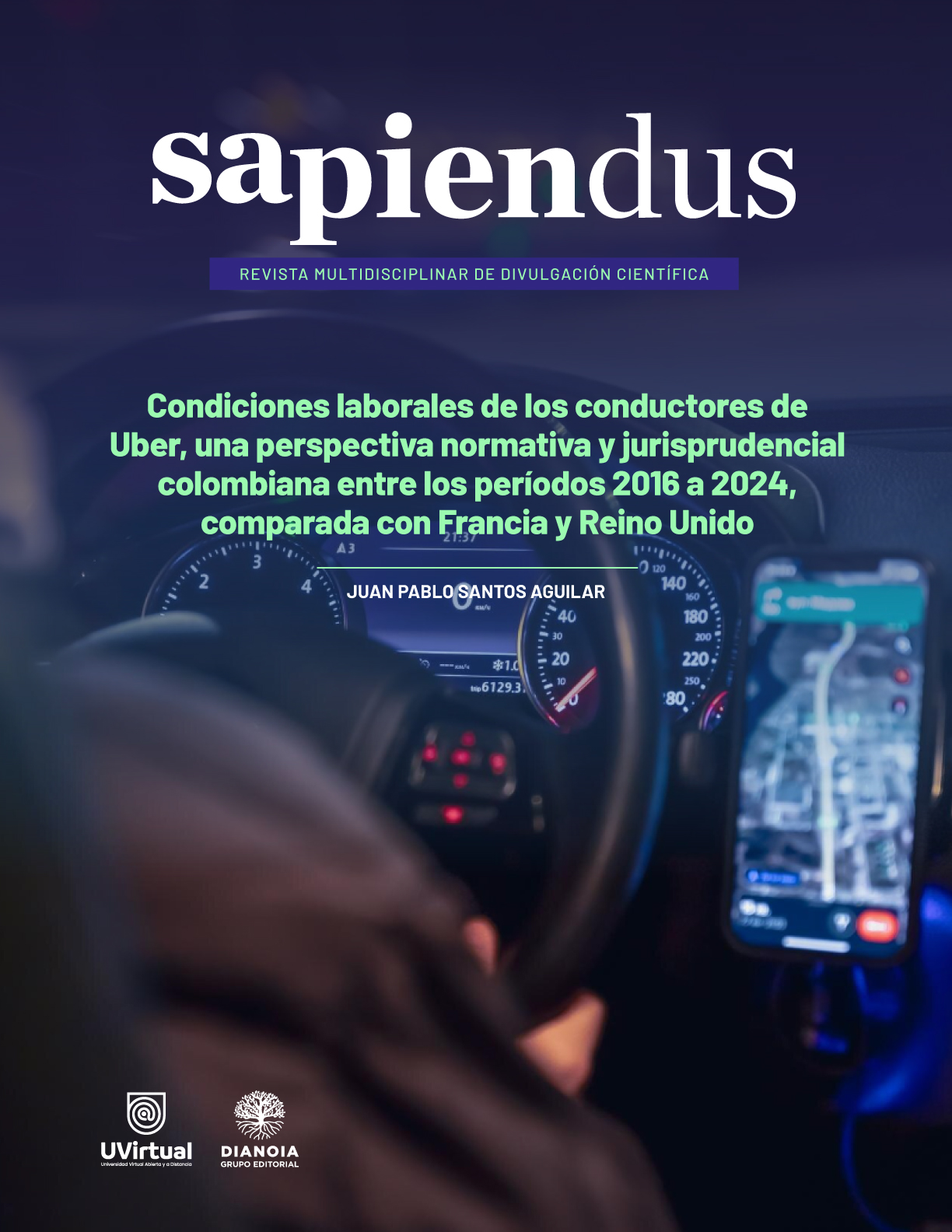
Working conditions of Uber drivers, a Colombian regulatory and jurisprudential perspective between the periods 2016 and 2024, compared to France and United Kingdom
DOI:
https://doi.org/10.70335/sapiendus.2.2.28Keywords:
Labor rights, colombian labor jurisprudence, french labor jurisprudence, english labor jurisprudenceAbstract
Introduction: This article aims to determine, from a comparative jurisprudential perspective, the protection and recognition of the labor rights of drivers affiliated with the Uber platform, beginning with an analysis of how this issue is addressed in France and the United Kingdom, in order to then examine how Colombia handles this matter. Objective: This article aims to con-
duct a study of the legal frameworks being adopted in countries such as France and the United Kingdom and to analyze their legal and/or jurisprudential regulatory framework in Colombia during the period from 2018 to 2024. Methodology: This is a qualitative study based on a comparative analysis at the case law level of the rights of drivers affiliated with or linked to the ‘Uber’ platform in Colombia, France, and England. Reflection: With regard to the personal provision of services, this is the requirement under which the assigned task must be performed throughout the duration of the employment relationship by the person who undertakes to fulfill it, thereby preventing the delegation of those functions to a third party outside the contractual relationship.
Downloads
References
Andrade Salazar, J. A. ., Mendoza Vergara, M. F. ., Zapata Castrillón, K. T. ., & Sierra Monsalve, L. . (2020). Relación entre conflictos de la adolescencia y habilidades sociales en adolescentes de una Institución Educativa de Risaralda. Pensamiento Americano, 13(25), 52-61. https://doi.org/10.21803/pensam.13.25.385
Bello, M. (2023). La aplicación del derecho al trabajo frente a las plataformas digitales en el servicio transporte y su regulacion en bogota D.C. desde el año 2013 hasta 2023. https://repository.unilibre.edu.co/bitstream/handle/10901/27808/ARTICULO%20CIENTIFICO%20PLATAFORMAS%20DIGITALES%20DE%20TRANSPORTE%20FINAL.pdf?sequence=2&isAllowed=y
Código Laboral Francés (1973). Artículo 8221-5
Congreso de la República de Colombia. (1951) Decreto 2663 de 1950. Código Sustantivo del Trabajo. D.O. No. 27.622.
Congreso de la República de Colombia. (2023) Ley 166 de 2023: Por el cual se expide el Plan Nacional de Desarrollo 2018-2022 Pacto por Colombia, Pacto por la equidad. D.O. No. 50.964.
Congreso de la República de Colombia. (1991) Constitución Política de Colombia. D.O. N° 47.013.
Corte Suprema de Justicia, Sentencia SL4330. (2020). https://consultajurisprudencial.ramajudicial.gov.co/WebRelatoria/csj/index.xhtml
Cour de cassation, civile, Chambre sociale, Sentencia 17-20.079 (2018). https://www.legifrance.gouv.fr/juri/id/JURITEXT000037787075
Cristancho, L. (2020) El concepto de trabajo: perspectiva histórica. https://www.scielo.org.mx/scielo.php?script=sci_arttext&pid=S0186-03482022000100105
Cruz Cadena, K., Caballero Palomino, S., Vásquez Gualdrón, L., & Moreno Ortiz, M. (2020). Alcance del control difuso de convencionalidad en las providencias judiciales en Colombia. Advocatus, (34), 37-46. https://doi.org/10.18041/0124/a.3436587
Díaz, M. (2024). Derechos laborales mínimos del trabajador digital desde la óptica de trabajo decente de la OIT en Colombia. Vínculo entre Uber y el conductor: ¿laboral o comercial? Estudios Socio-Jurídicos, 27(1). https://doi.org/10.12804/revistas.urosario.edu.co/sociojuridicos/a.14637
Fernández M. (2020). La prestación de servicios a través de plataformas digitales. El caso deliveroo. https://www.studocu.com/pe/document/universidad-nacional-jose-maria-arguedas/contabilidad/dialnet-la-prestacion-de-servicios-atraves-de-plataformas-digital-7464150/82259511
Azuara, O., & González, S. (2020). ¿Quiénes son los conductores que utilizan las plataformas de transporte en América Latina? Banco Interamericano de Desarrollo (BID). https://publications.iadb.org/es/publications/english/viewer/Who_Uses_Ride-Hailing_Platforms_to_Drive_in_Latin_America_A_Profile_of_Uber_Drivers_in_Brazil_Chile_Colombia_and_Mexico_en.pdf
Organización Internacional del Trabajo. (s.f.). Revista de Trabajo, 67. https://www.ilo.org/es/publications/revista-trabajo-67-diciembre-de-2009-la-seguridad-social-como-respuesta-la
Ospina, E. (2021). El trabajador digital, entre la inclusión y la exclusión protectoria. https://dialnet.unirioja.es/descarga/articulo/8041239.pdf
Rodríguez, J. (2004). Curso de derecho del trabajo y de la seguridad social https://www.calameo.com/read/003354746e58796bdec76
The supreme court, Sentencia UKSC/2019/0029 (2021). https://supremecourt.uk/uploads/uksc_2019_0029_judgment_19c9de2253.pdf?utm_source
Bardey, D. (2022) El trabajo intermediado por plataformas en Colombia: aspectos conceptuales y propuesta de regulación desde la teoría de contratos y la organización industrial (Documentos de Proyectos, No. 47906) Comisión Económica para América Latina y el Caribe (CEPAL).
Additional Files
Published
Issue
Section
License
Copyright (c) 2026 Sapiendus

This work is licensed under a Creative Commons Attribution-NonCommercial-NoDerivatives 4.0 International License.
The author or authors of an article accepted for publication in the Journal Pensamiento Americano will transfer all of the patrimonial rights to the American University Corporation free of charge, within which are included: the right to edit, publish, reproduce and distribute both print media as digital, in addition to include in article in international indexes and / or databases, likewise, the Editorial Seal is authorized to use the images, tables and / or any graphic material presented in the article for the design of covers or posters from the same magazine. By assuming the patrimonial rights of the article, it may not be partially or totally reproduced in any printed or digital media without its express permission.
AUTHORITY ASPECTS
For the Pensamiento Americano Journal, all the authors of an article have made substantial contributions to the research and the manuscript, and they share the responsibility when the article presents errors, fraud in some way or violations of copyright.
After submitting an article, the journal does not accept the addition, deletion or change in the order of the authors, in addition we reserve the right to release the article when it has been submitted to the journal and under no circumstances will American Thought accept the article. withdrawal of an article during any phase of the editorial process